
by Jocelyn Qassis – February 2026 –
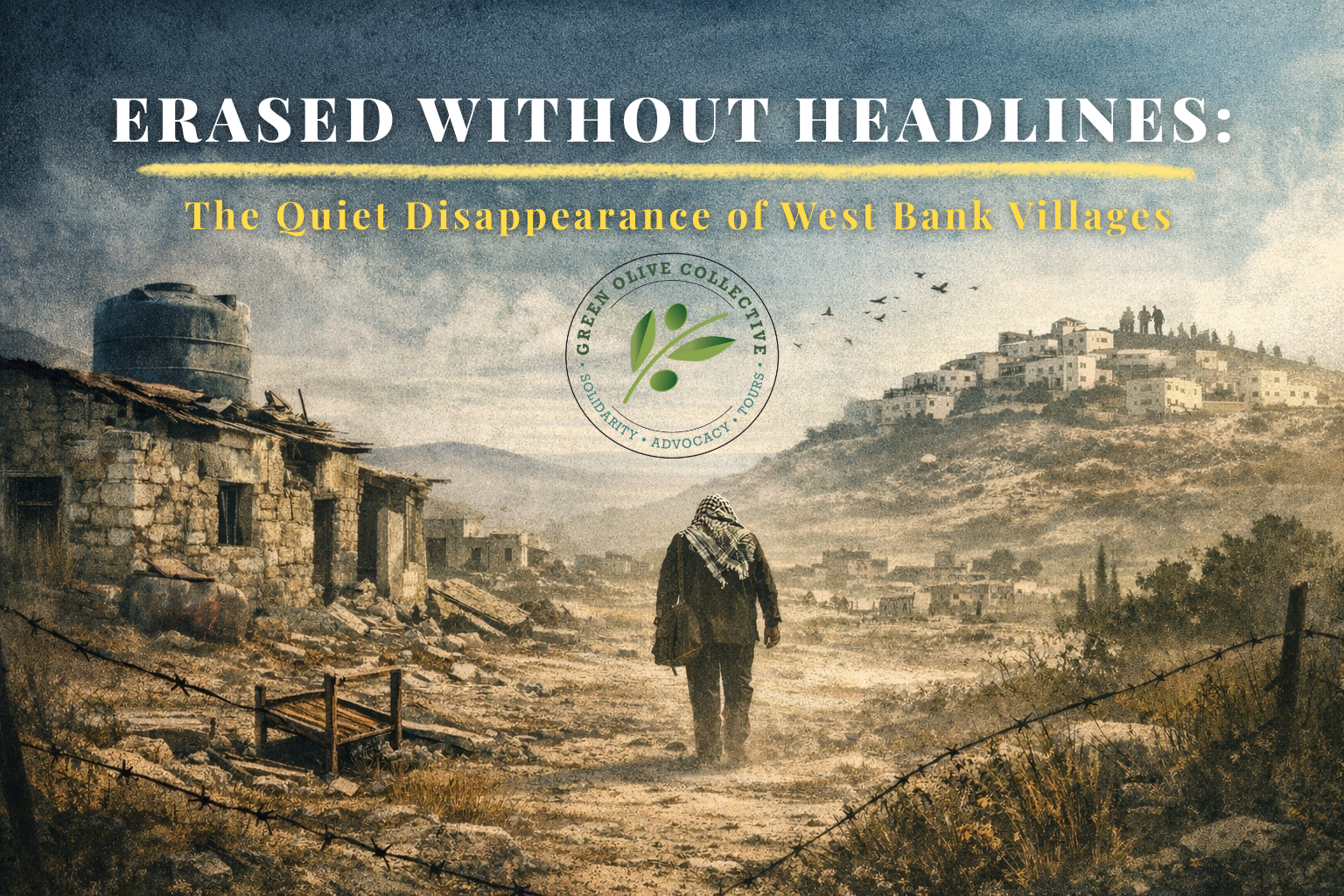
They did not leave all at once. They left slowly, until nothing was left.
In conflicts shaped by headlines, numbers often blur into abstraction. Yet sometimes statistics point to something far more concrete: land that is no longer accessible, homes that no longer stand, and communities that no longer exist where they once did.
Across large stretches of the West Bank, entire Palestinian communities have quietly disappeared from the landscape since late 2023. Dozens of rural localities that once sustained families, herds, and agricultural life now stand empty — their residents displaced after prolonged waves of intimidation and mounting pressure. In some places, abandoned homes still hold water tanks on their roofs and tools in their yards — traces of lives interrupted rather than relocated.
Many of these communities have been fully abandoned, while others continue to empty gradually as conditions grow increasingly untenable. Far from isolated incidents, the pattern traces a clear geographic arc across strategically sensitive areas — from the Jordan Valley to the South Hebron Hills, and from the eastern outskirts of Ramallah to the rural edges southeast of Bethlehem — regions long understood as pivotal in shaping territorial realities.
The disappearance of rural communities did not begin in late 2023. Since October 7th alone, more than 1,600 Palestinians have been displaced from at least 28 rural communities across the West Bank, according to UN monitoring bodies. Entire villages such as Wadi al-Seeq and Ein Samiya were abandoned following sustained intimidation, access restrictions, and violent incidents. Yet these recent developments unfold within a much longer historical trajectory of territorial displacement that dates back to 1967.
What is unfolding is not a single event, but a process — one that reshapes geography not through declarations, but through absence.
Land as a Method of Control
Land in the West Bank is not simply territory. It is livelihood, identity, history, and continuity. When communities are pushed off their land, the consequences extend beyond relocation. Families lose grazing routes, agricultural income, access to water sources, and intergenerational ties to place. In rural economies, displacement is not temporary disruption; it is structural erasure.
Recent months have seen the appearance of dozens of new outposts and farms across the West Bank landscape, several established near Palestinian communities that were later abandoned. The proximity is not incidental. It reflects a pattern documented for years by monitoring organizations: instability frequently precedes land takeover, and localized pressure often becomes a precursor to spatial transformation.
In recent months, new agricultural outposts such as Meitarim Farm in the South Hebron Hills and Sde Yonatan in the Jordan Valley have emerged near Palestinian communities that were subsequently abandoned. These are not isolated developments; they reflect a pattern in which newly established outposts consolidate control over grazing land and strategic corridors following rural displacement.
Structural Logic: Displacement as Territorial Strategy
To understand these developments solely as local incidents is to miss their structural significance. What appears as scattered rural displacement is better understood as a spatial mechanism — one that gradually reorganizes control over land without requiring formal annexation or large-scale military operations.
Territorial power in modern conflicts is rarely asserted through dramatic conquest. More often, it is consolidated through administrative decisions, infrastructural limitations, legal classifications, and localized pressure that cumulatively reshape who can remain on the land and who cannot. In such contexts, displacement functions not as an accidental by-product of instability, but as a mechanism through which geographic realities are quietly restructured.
This form of territorial transformation is particularly consequential because it operates below the threshold that typically triggers international intervention. Without a singular defining event, the process produces no obvious moment of crisis — only a steady alteration of facts on the ground. By the time attention arrives, the landscape itself may already have changed.
From a geopolitical perspective, gradual demographic shifts often prove more durable than formally negotiated arrangements. Agreements can be revised; population distribution on the ground is far harder to reverse. For this reason, spatial dynamics frequently precede political outcomes rather than follow them.
The structural context becomes clearer when examining demographic expansion. In 1972, the settler population in the West Bank stood at approximately 1,200. By 1990, it had reached nearly 78,000. By 2023, the number exceeded 500,000 in the West Bank alone, and over 700,000 when including East Jerusalem. This steady demographic growth across five decades has fundamentally reshaped territorial dynamics, often preceding political negotiations rather than following them.
Seen in this light, the disappearance of rural communities is not only a humanitarian concern. It is a structural development with long-term implications for territorial configuration, governance possibilities, and future negotiations. The geography of a conflict is never neutral. It is produced, maintained, and transformed — sometimes quietly, but never accidentally.
Historical Pattern
Forced displacement in rural areas of the West Bank did not begin recently. For decades, land designation systems, planning restrictions, settlement expansion, and access limitations have steadily reduced the space available for Palestinian agricultural life. What distinguishes the present moment is not the existence of pressure, but its acceleration and geographic concentration.
Following the 1967 war, between 200,000 and 300,000 Palestinians were displaced from the West Bank and Gaza. In the decades since, over 28,000 Palestinian homes have been demolished in the West Bank and East Jerusalem. The cumulative effect of land designation systems, restrictive planning regimes, and expanding settlement infrastructure has steadily narrowed the geographic space available for Palestinian rural life.
Historical precedents demonstrate that gradual territorial shifts rarely occur through a single decisive act. Rather, they unfold through cumulative administrative, infrastructural, and social pressures that reshape realities over time.
The Geography of Pressure
Displacement rarely happens overnight. Instead, it unfolds through layers of sustained constraint:
- restricted movement
- intimidation
- destruction of property
- attacks on livestock
- blocked access to farmland
Over time, daily life becomes untenable. Families leave not because they choose to, but because remaining becomes impossible. In several areas of the South Hebron Hills, small herding communities that once relied on seasonal grazing routes have been forced to abandon them after repeated access restrictions and intimidation incidents documented by monitoring groups.
Monitoring groups have documented hundreds of incidents involving land access restrictions, vandalism, and rural violence in recent months alone — indicators not of isolated clashes, but of measurable escalation.
This form of displacement is difficult to capture in traditional news cycles because it is gradual rather than spectacular. Yet its long-term implications are profound: when communities disappear, maps change. And when maps change, political realities follow.
The Logic of Silence
The absence of dramatic moments does not signal the absence of transformation. On the contrary, quiet processes can be the most structurally consequential precisely because they unfold without spectacle.
Gradual change rarely triggers international thresholds of alarm. Without sudden crises or singular turning points, structural shifts can advance largely unnoticed — even as they reshape the facts on the ground in lasting ways.
Why This Matters Beyond the West Bank
Stories like these seldom dominate global headlines, yet they reveal something essential about how power operates spatially. Territorial change is not always declared through formal annexation or legislative acts. Often, it emerges through incremental adjustments that appear local but accumulate into systemic transformation.
When rural communities disappear, it is not only people who are displaced. Agricultural systems collapse, land use patterns shift, and political realities adjust accordingly. In many conflicts throughout modern history, demographic and geographic changes on the ground have ultimately shaped outcomes more decisively than diplomatic negotiations.
Understanding these dynamics is central to understanding the broader conflict itself. Without attention to land, discussions risk focusing on political frameworks while overlooking the realities that determine them.
Bearing Witness as Responsibility
For organizations committed to ethical engagement and responsible travel, documenting these realities is not advocacy theatre — it is grounded observation. Witnessing conditions on the ground allows visitors, researchers, and readers alike to move beyond simplified narratives and encounter the lived experiences that statistics alone cannot convey.
Responsible engagement, in this sense, is not passive observation. It is informed presence.
Conclusion
The disappearance of villages is not only a humanitarian concern; it is a geographic transformation with enduring consequences. When communities vanish from the landscape, what disappears with them is more than housing. It is memory, culture, livelihood, and belonging.
Understanding these shifts is essential for anyone seeking to grasp what is unfolding in the West Bank today — not as a distant political abstraction, but as a lived reality changing quietly, village by village, field by field.
Methodology Note: This analysis is informed by field-based observation and verified open-source reporting.
Sources
- +972 Magazine — The West Bank villages wiped off the map by Israeli settler violence
- UN OCHA — West Bank Situation Reports
- B’Tselem — Documentation on Displacement and Settler Violence

Comment (0)