
Between Celebration, Memory, and the Unfinished Search for Peace
• By Fred Schlomka •
A City Reawakens After Silence
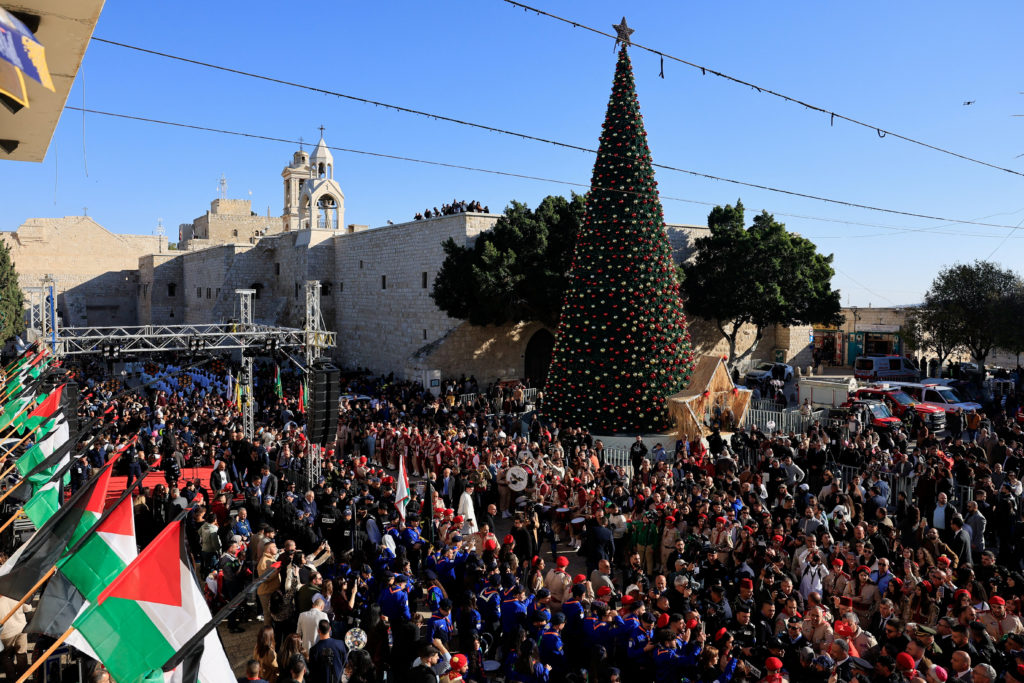
It has been three years since Christmas was last celebrated in Bethlehem due to the horrific events of October 7th and the Gaza apocalypse. The contrast between this year’s celebration and last year is striking. The deserted streets have now been transformed with decorations and crowds of Palestinians jostling with tourists to see the grand parade and lining up at the entrance to the Church of Nativity to view the grotto deep in the bowels of the church, historically the birthplace of the Judean known as Jesus, worshiped by countless Christians around the world as the savior of humankind.
Morning in Beit Sahour
I began my visit on Christmas day in the Christian Bethlehem suburb of Beit Sahour, site of the Chapel at Shepherds’ Field, a Roman Catholic site commemorating the angel’s announcement of Jesus’ birth to the shepherds. My colleague Mirvate lives nearby and we share coffee and conversation before I start the two-mile walk up the hills to the centre of Bethlehem.
She runs our guesthouse and tells me that for reasons unknown, AirBnB is refusing to transfer funds paid by our guests, likely for political reasons. Transferring funds to Palestine has become increasingly difficult as Israel continues to tighten the screws on Palestinian life. Merry Christmas.
The Walk Toward the City
The walk from Beit Sahour to Bethlehem snakes through a commercial strip. The shops, mostly Muslim, are all closed for the holiday. Since the 1950s when the Christian population in Bethlehem was over 80%, the population has now shrunk to about 10% of the 30,000 residents, mainly due to the pressures of the Israeli occupation and the limited opportunities to build a decent life.
Christians tend to be more affluent than their Muslim neighbors and have the resources to emigrate, denied to the vast majority of Palestinians.
A Shared Holiday
When President Yasser Arafat established the Palestinian Authority in the 1990s, Christmas was declared an official national holiday and today it is celebrated by many Muslims who flock to the city to share the festivities. In an interesting parallel, Jewish-Israelis also increasingly celebrate the holiday. Tel Aviv is full of restaurants advertising Christmas dinners and other events.
Star Street: The Pulse of Festivity
As I approach Manger Square, the crowds thicken and I take a route along Star Street, a twisting narrow alley with open shops selling sweets and tourist trinkets. Vendors vie with each other to command attention, and roaming coffee sellers with their huge brass rakweh keep the crowd supplied with rich brew.
I examine a traditional farwa coat said to be locally made, only to discover a hidden label marked “Made in China.” I leave disappointed.
Manger Square Alive
The lane opens into Manger Square. A huge Christmas tree dominates the plaza, surrounded by wheeled carts selling popcorn, balloons, and toys. Seasonal banners hang from buildings, and the festive atmosphere is infectious.
Children run laughing while adults smile — a striking contrast to the serious realities they endure. Tourists are still a minority, as much of the world remains hesitant to visit Palestine.
The Church of the Nativity: Layers of Time
The Church of Nativity towers above the scene. Massive limestone walls rise from this ancient holy site rebuilt many times over two millennia. The current structure largely dates to the 6th century, when Byzantine Emperor Justinian I rebuilt the earlier church.
The original 4th-century basilica was commissioned by Constantine’s mother, St. Helena, and parts of its mosaics still remain.
Art, Walls, and Contrasts
I leave Manger Square to meet an owner of the Walled Off Hotel, designed and financed by English artist Banksy, just meters from Israel’s 25-foot concrete separation wall near Rachel’s Tomb. The hotel briefly reopened for the Christmas season and will close again in January.
Seeds of Resistance Through Culture
Later I meet Mustafa, who runs a youth centre in Aida Refugee Camp. We plan peaceful co-resistance projects. One initiative will bring music education to remote West Bank villages, modeled on the “Island Ukuleles” program my wife and I created in Shetland — except here it will feature the Oud, a traditional Middle Eastern instrument.
The Parade of Youth and Sound
Festivities spill back into Beit Sahour where the parade features bagpipe bands run by scouts and youth organizations. The procession stretches for nearly a mile. Boys and girls perform Arabic music and Western carols while drummers keep rhythm even when others pause. Pipe majors twirl batons high into the air, delighting the crowd.
Bagpipes remain a legacy of the British occupation (1919–1948), still found across former British territories — even in Jaffa, where I live when here.
After the Celebration
Now the season is over. Christmas has passed, and despite the joy, the reality of occupation in Bethlehem and the West Bank remains ever present. Demolitions continue. Violence continues.
Perhaps if the world truly awakens and acts, a future Christmas in Bethlehem may arrive when we can genuinely celebrate the promise of peace “that surpasses all understanding” (John 14:27). May we all live to see that day.
Author
Fred Schlomka divides his time between Shetland and Jaffa, where he is co-Managing Partner of the Green Olive Collective — an Arab/Jewish Israeli/Palestinian organization advocating for a just peace, democracy, and human rights.

Comment (0)