
by Jocelyn Qassis , March 2026
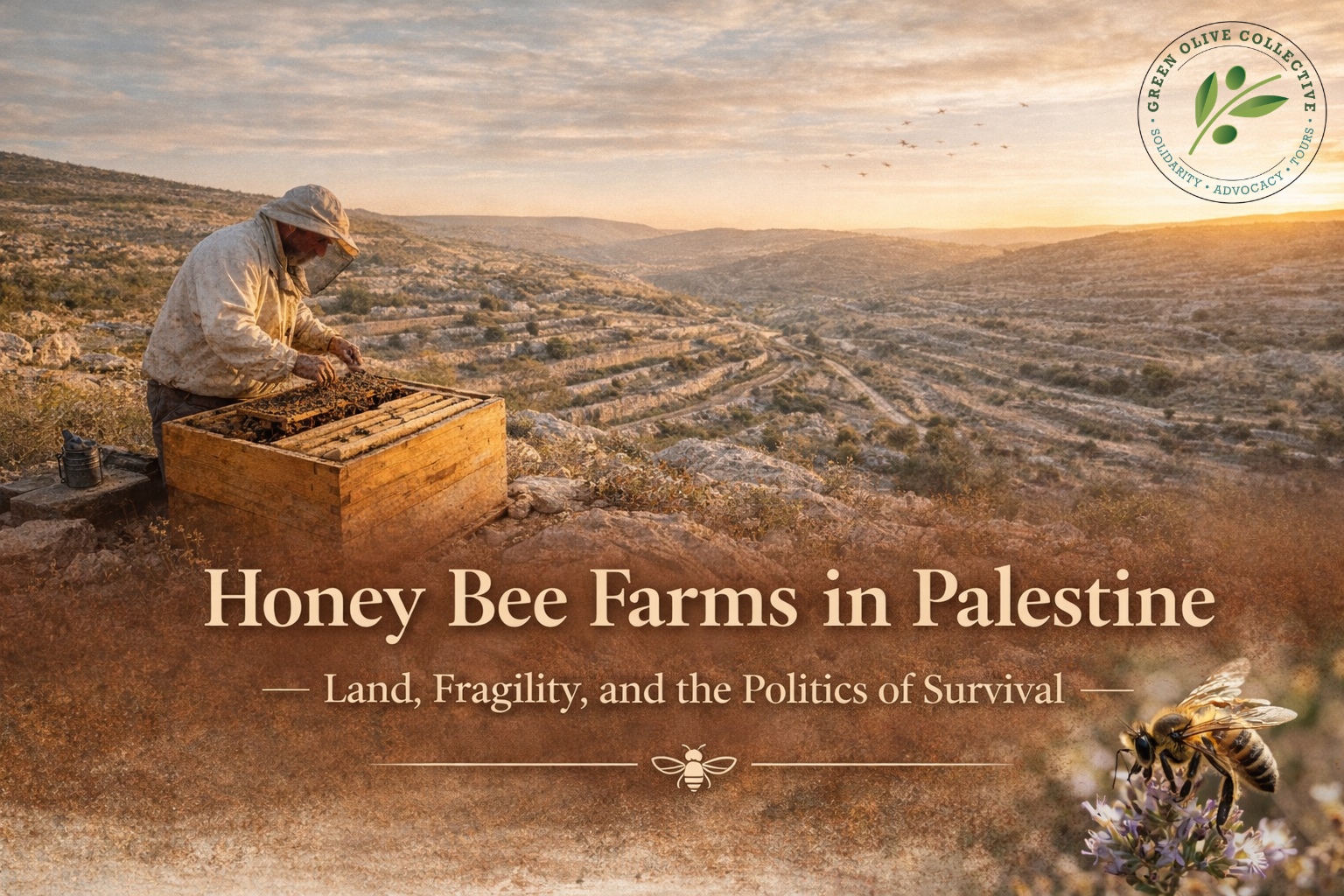
“When they burned the hives, it wasn’t just honey we lost.”
At sunrise in the hills south of Hebron, a beekeeper lifts the lid of a wooden hive. The air is sharp with thyme. Bees rise and settle in a controlled hum. Inside, order prevails: wax foundations, carefully formed cells, nectar thickening into honey.
Last year, some of those hives were reduced to ash.
“When they burned the hives, it wasn’t just honey we lost,” one beekeeper explained in reporting from the South Hebron Hills. “It was the season. It was the next year.”
In Palestine, honey is never just a product. It is a seasonal investment, an ecological relationship, and increasingly, a measure of whether rural life is allowed to continue.
Pollination: The Quiet Backbone of Agriculture
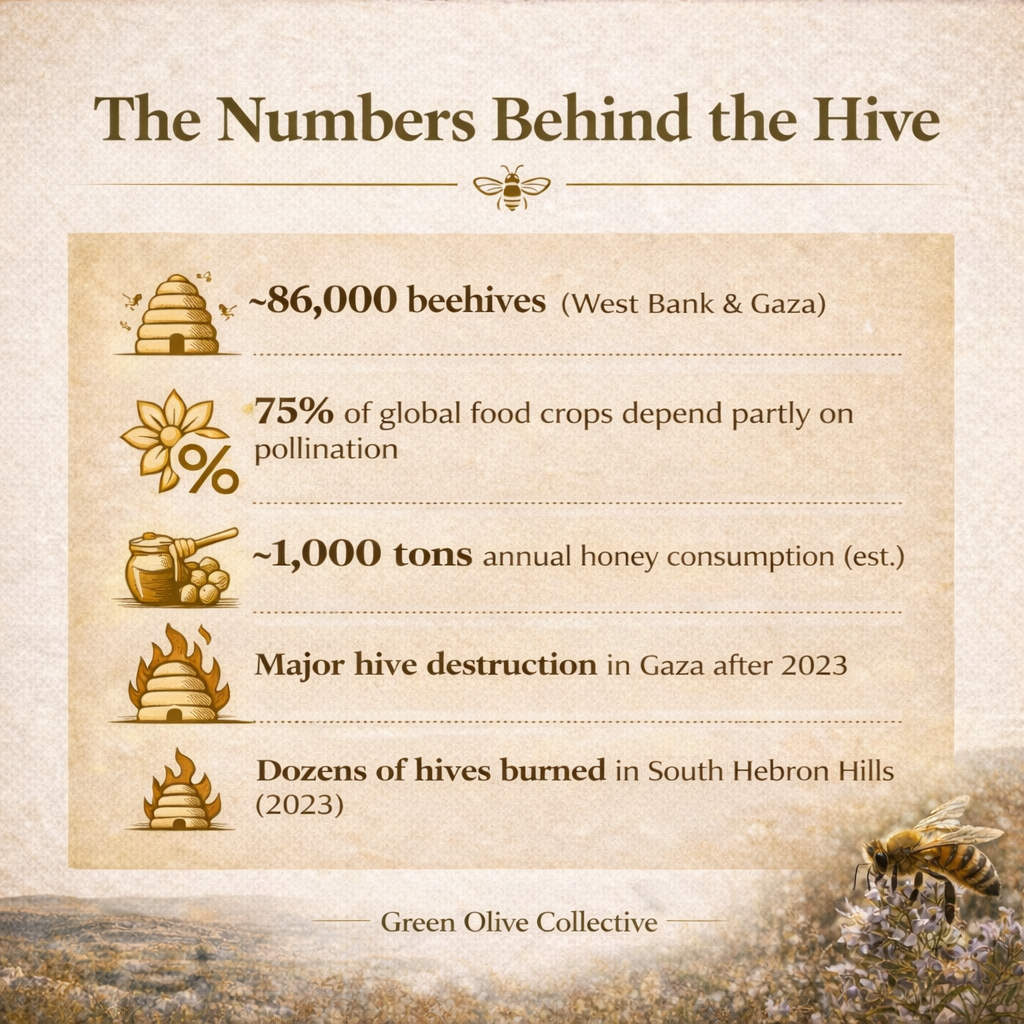
Globally, roughly three quarters of major food crops depend at least partially on animal pollination. In a region where agricultural land is fragmented and water is scarce; pollination is not an abstract environmental issue. It is a pillar of food security.
In Palestine, bees sustain olive groves, almond blossoms, citrus orchards, and wild herbs that support both biodiversity and rural income. When hives disappear, the effect is not isolated to honey yields. Pollination declines, harvests shrink, and ecological balance weakens.
Beekeeping here is environmental infrastructure community resilience.
A Sector with Potential and Imposed Structural Limits
Estimates indicate there are between 80,000 and 90,000 active beehives across the West Bank and Gaza. Yet local honey production does not fully meet domestic consumption. Imported honey fills the gap, often at lower prices, putting additional pressure on Palestinian producers already operating with higher risks.
Beekeeping is not failing because of lack of demand or expertise. It is constrained by the layered instability imposed by military occupation: fluctuating land access, rising input costs, climate volatility, and exposure to violence. A beekeeper must account not only for nectar flow and rainfall, but for checkpoint delays, restricted valleys, uncertain seasons, and all the mechanisms of apartheid and the ongoing Nakba.
The hive is biological. The risk is political.
South Hebron Hills: Land, Fire, and Displacement
The South Hebron Hills illustrate how quickly agricultural stability can unravel. Reporting in 2023 documented incidents in which settlers burned dozens of Palestinian-owned hives. In one case, approximately 50 hives were destroyed in a single attack.
For a beekeeper, that is not symbolic damage. Each hive represents months of labor, wax frames, equipment, and anticipated income. Colonies cannot simply be replaced overnight. When hives are destroyed, recovery can take years.
But destruction does not stop at equipment. Beekeeping depends on access to flowering landscapes. As settlement outposts expand and rural communities face displacement, forage areas become inaccessible or unsafe. Bees may cross boundaries, but beekeepers living under apartheid cannot. When land is lost, pollination routes disappear with it.
In the South Hebron Hills, honey production has become entangled with the broader geography of control and with the popular struggle of Palestinian communities to remain on their lands.
Gaza: Ecological Collapse Under War
In Gaza, beekeeping has faced a different but equally devastating trajectory. Climate stress had already begun reshaping flowering cycles and honey yields. Following the recent war, agricultural systems, including apiaries, were severely damaged.
Reports indicate that a vast majority of active hives were destroyed or abandoned due to direct destruction, vegetation loss, and displacement. Bees require stable ecosystems. When farmland is flattened and vegetation disappears, pollination networks collapse.
Rebuilding hives is possible. Rebuilding entire ecological systems takes far longer.
Climate, Disease, and the Cost of Adaptation
Even in relatively stable areas, beekeeping remains vulnerable. Rising temperatures alter blooming schedules. Rainfall becomes erratic. Nectar flows shorten. Disease outbreaks, including American foulbrood, threaten colony health.
Operating a hive requires constant management: replacing wax foundations, monitoring disease, relocating colonies, supplementing feed when blossoms fail. These are technical and financial burdens. Innovation initiatives, such as beeswax recycling and improved processing methods, have strengthened resilience in parts of the sector. But adaptation has limits when instability is systemic.
The Political Ecology of Honey
Beekeeping in Palestine sits at the intersection of ecology and politics. Bees follow nectar across hills and valleys, unconcerned with administrative lines. The humans who manage them, however, navigate checkpoints, land classifications, shifting restrictions, and the Israeli permit regime.
When rural communities are displaced, it is not only homes that vanish. Agricultural networks fragment. Grazing routes disappear. Forage valleys become contested terrain. The quiet disappearance of hives becomes part of a broader reshaping of space and a central strategy in the displacement of Palestinians.
Honey, in this context, becomes an archive of access, or of its denial.
Why Ethical Partnership Matters
This is why Green Olive’s engagement with honey bee farms is not symbolic. In Umm il-Kheir, where we worked with the community to rehabilitate a honey bee farm last April, Israeli settlers in Carmel complained to the military that the bees were flying over their barbed wire fence and into the settlement. The military then ordered the community to dismantle the honey bee farm and relocate it further from the settlement in an attempt to segregate even the wind, bees, and air. This process caused significant damage to the honey bee boxes.
When the Green Olive Collective mobilizes in solidarity with Palestinian bee keepers, we do so with a clear understanding that working with the farmers to rehabilitate honey bee farms is not only symbolic, but an act of explicit opposition to military rule, segregation, ethnic cleansing, and the ongoing Nakba.
Supporting local producers also contributes directly to economic continuity as part of broader mutual aid efforts. Direct purchasing ensures income remains with the beekeeper and within Palestinian communities. And ensures that visitors understand the steadfastness that sustains the product they are tasting and the system of occupation that threatens it.
A responsible visit to a honey farm does not romanticize rural life. It connects visceral experience with structural reality. Guests learn how flavor is shaped by flowering cycles, how wax must be replaced seasonally, and how the imposed instability of military occupation can interrupt an entire year’s work.
Ethical and liberatory tourism, at its best, strengthens the systems it encounters rather than extracting from them.
Continuity Is Not Guaranteed
A jar of Palestinian honey carries more than floral notes. It carries the imprint of thyme_covered hillsides, the cost of transport through restricted roads, the uncertainty of land access, and the persistence of those who continue working despite both.
Beekeepers return each season not because conditions are stable, but because stopping would mean relinquishing both livelihood and connection to land. Pollination continues season after season even when the surrounding structures strain.
In Palestine, sustaining a hive has become a way of sustaining presence.
And that may be the most fragile and most powerful architecture of all.
Sources & Further Reading
Intergovernmental Science-Policy Platform on Biodiversity and Ecosystem Services (IPBES). The Assessment Report on Pollinators, Pollination and Food Production. 2016.
Food and Agriculture Organization of the United Nations (FAO). Driving Innovation in the Palestinian Beekeeping Industry through Beeswax Recycling. 2020.
+972 Magazine. “Settlers Burn Palestinian Beehives in the South Hebron Hills.” 2023.
Gisha – Legal Center for Freedom of Movement. The War on Food Production: The Agricultural Sector in Gaza. 2025.
Palestinian Central Bureau of Statistics (PCBS). Agricultural Statistics Annual Report.

Comment (0)