
Jocelyn Qassis / March 2026
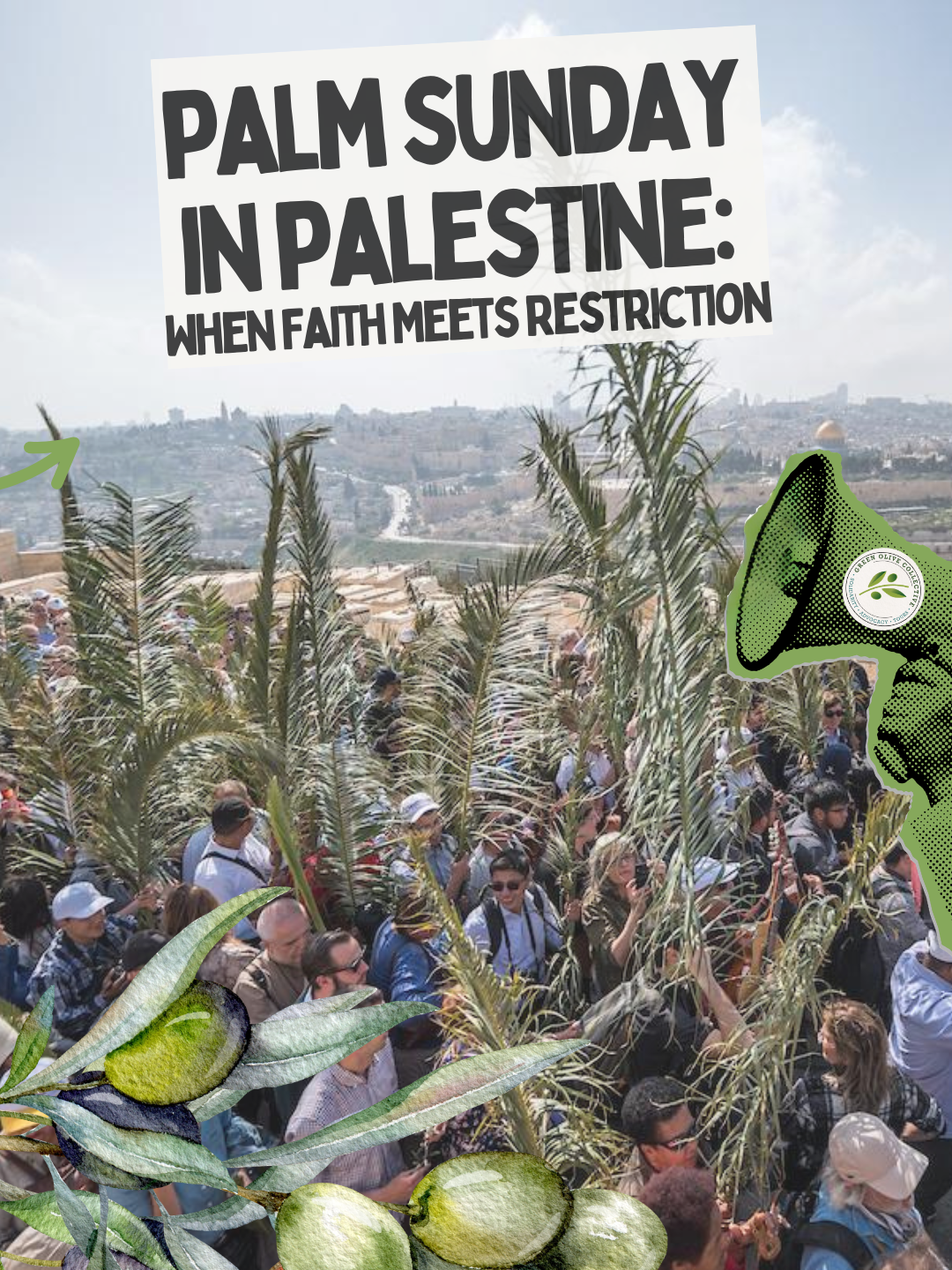
Palm Sunday arrives this year under a sky heavy with uncertainty. In a region shaped by ongoing tension, the familiar sounds of celebration church bells, hymns, and processions feel more subdued. What is usually a day of public joy is now unfolding quietly, shaped by restriction and absence.
In Jerusalem, the Old City no longer carries the same crowds that once filled its streets with palm branches and song. The atmosphere has shifted. Movement is limited, access is uncertain, and for many Palestinian Christians, reaching the city itself has become a challenge rather than a tradition.
At the center of this moment stands the Church of the Holy Sepulchre, a place that has, for centuries, drawn worshippers from across the world. This year, access has been tightly controlled. Entry was limited, and at certain points, doors were closed to manage the flow of people. For many, that meant standing just outside, close to one of Christianity’s holiest sites, yet unable to enter.
Inside churches, the rituals continue. Palm branches are still raised, olive branches still carried, and hymns welcoming “the one who comes in the name of the Lord” are still sung. But beyond the rituals, there is a quieter reality shaping the day, one defined by uncertainty and distance.
On the morning of Palm Sunday, that reality became even more visible. Israeli police prevented the Latin Patriarch of Jerusalem, Cardinal Pierbattista Pizzaballa, along with the Custos of the Holy Land, Father Francesco Patton, from entering the Church of the Holy Sepulchre as they made their way to lead the Palm Sunday Mass. They were stopped along the way, without any public procession, and were required to turn back.
In an unprecedented move in recent years, senior church leaders were unable to preside over Palm Sunday prayers inside the church. The moment marked a break in what is usually a continuous and deeply rooted religious tradition.
The impact extends beyond those present. This is a week when millions of Christians around the world turn their attention to Jerusalem. Yet public gatherings have been restricted, attendance reduced, and celebrations shifted in part toward broadcast rather than physical presence.
And still, the meaning of the day remains.
Palm Sunday does not depend only on access to a place. Its message continues in smaller gatherings, in quiet prayers, and in the persistence of those who choose to observe it despite the limitations around them. In cities like Bethlehem and Ramallah, communities continue to mark the day in more limited but meaningful ways.
Here, faith is not only expressed through celebration.
It is carried quietly, steadily as a form of endurance.
For me, Palm Sunday was always a day of movement, of voices, of feeling that I belong to this place and its story. This year, it feels heavier. It is no longer just about celebration, but about holding on to faith, to memory, and to something that feels increasingly out of reach. There is a quiet tension in marking the day, a sense that what once felt natural now requires effort, patience, and persistence. And maybe that is what makes it matter even more now: not because it is easy to celebrate, but because it is not.

Comment (0)