
Jocelyn Qassis _ July 2026
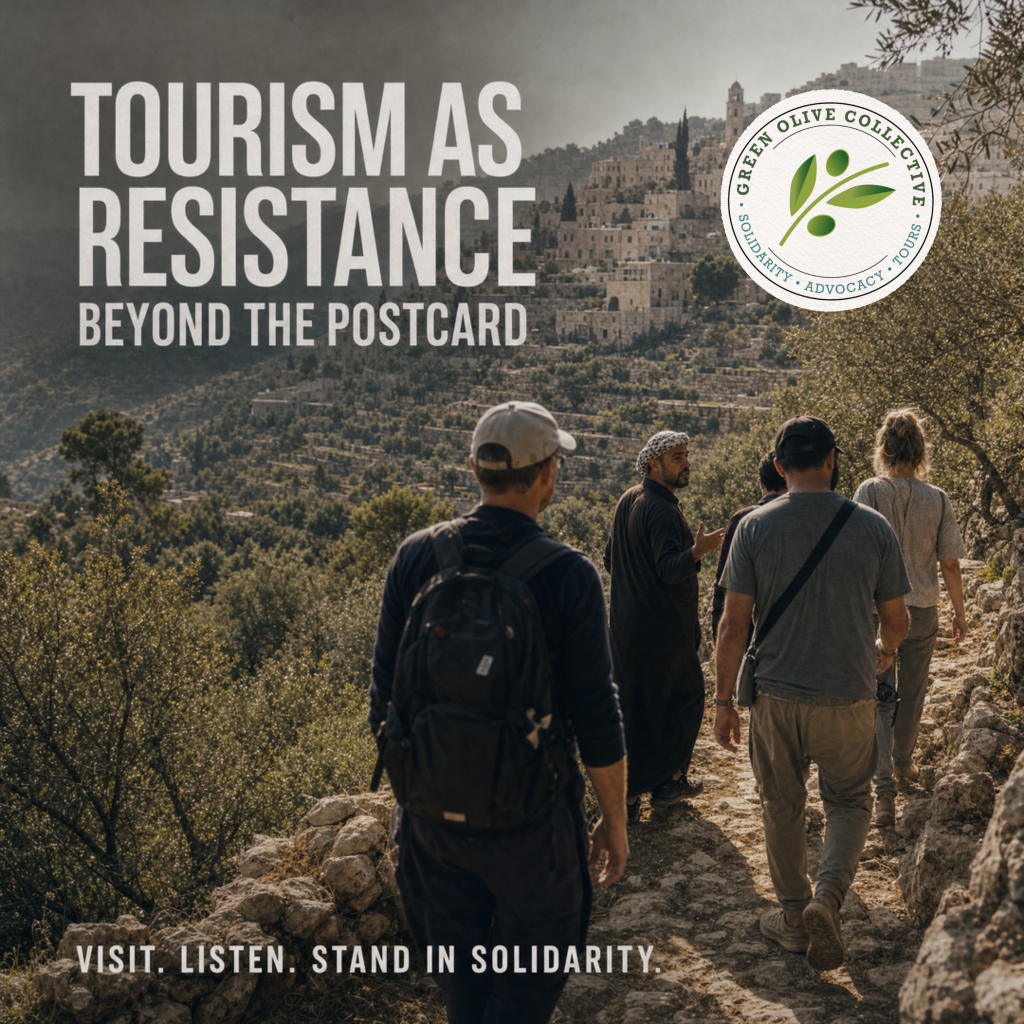
When most people think of tourism, they imagine leisurely strolls through ancient ruins, snapping photos of historical landmarks, and enjoying local cuisine. But in Palestine, tourism is fundamentally different. It is not merely an industry; it is a profound act of resistance. In a land where movement is restricted, where geography is systematically erased, and where the economy is suffocated by occupation, choosing to visit Palestine and choosing how to visit becomes a powerful political statement.
For decades, the traditional tourism industry in the region has been co-opted to serve a narrative that marginalizes Palestinian existence. Millions of tourists visit the “Holy Land” each year, yet many remain completely unaware of the realities unfolding just a few miles away from their comfortable hotels. They pass through checkpoints without understanding their implications and visit religious sites while the indigenous population is often denied access to those very same places. However, a new wave of conscious travelers is beginning to change this dynamic, transforming their journeys into acts of solidarity and resistance.
The Economics of Occupation: Who Really Profits?
To understand why visiting Palestine is an act of resistance, one must first understand the economics of the occupation. The tourism sector is a vital component of the Palestinian economy, yet it is heavily restricted and exploited. According to estimates by former Palestinian Tourism Minister Hani alhayek, Israel collects approximately 90% of pilgrim-related revenue [1]. This staggering figure reveals a deliberate strategy to monopolize the economic benefits of tourism while simultaneously stifling Palestinian enterprise and self-determination.
The mechanisms of this exploitation are deeply embedded in the daily operations of the tourism industry. For instance, in Bethlehem one of the most significant tourist destinations globally Palestinian shop owners are often forced to pay an average of 35% commission to Israeli tour operators simply to bring tourists to their stores [1]. This unequal power dynamic ensures that even when tourists visit Palestinian cities, the financial benefits are disproportionately siphoned away from the local communities. It is a system designed to extract wealth while maintaining the appearance of economic activity.
Furthermore, the bureaucratic hurdles imposed by the occupation make it exceedingly difficult for Palestinians to thrive in this sector. Obtaining permits to set up travel agencies, become licensed tour guides, or build hotels requires authorization from Israeli authorities authorization that is rarely granted [1]. This systematic economic marginalization is designed to create dependency and weaken the social fabric of Palestinian society. It is a form of structural violence that operates through administrative procedures rather than overt force.
Despite these immense challenges, the Palestinian tourism sector has shown remarkable resilience and determination. According to the Palestinian Central Bureau of Statistics (PCBS), the first half of 2025 witnessed a significant improvement in tourism indicators in the West Bank. The number of hotel guests increased by 103% compared to the same period in 2024, reaching 121,400 guests [2]. Moreover, the number of day visits by incoming and local visitors surged by 57%, totaling approximately 2.626 million visits [2]. These numbers are not just statistics; they represent a lifeline for thousands of Palestinian families, a testament to the enduring spirit of a people determined to survive and thrive despite overwhelming odds.
Notably, 53.3% of hotel guests were Palestinians residing in the 1948 territories, followed by domestic guests at 24.7%, while international visitors constituted 22% [2]. This composition reveals an important truth: Palestinians themselves are the primary supporters of their own tourism sector. They are investing in their own communities, supporting their own businesses, and refusing to allow the occupation to sever their connections to their homeland.
The Devastation in Gaza: A Contrast in Realities
While the West Bank has seen a fragile recovery, the situation in the Gaza Strip presents a stark and devastating contrast. The systematic destruction caused by the Israeli aggression has obliterated the tourism sector in Gaza. Recent data indicates that approximately 4,992 tourism-related establishments were completely destroyed [2]. This includes 3,450 restaurants and beverage establishments, 921 creative arts and entertainment venues, and 173 hotel accommodations [2].
The human cost of this destruction is immeasurable. The aggression led to the loss of jobs for 15,265 workers in the tourism sector in Gaza alone [2]. Behind every number is a family stripped of its livelihood, a dream shattered, and a community plunged into deeper despair. When we talk about tourism in Palestine, we cannot ignore the deliberate erasure of life and culture in Gaza. It serves as a grim reminder of the broader context in which Palestinian tourism operates a context of ongoing violence and systemic oppression.
The destruction of Gaza’s tourism infrastructure is not a collateral damage; it is a strategic dismantling of Palestinian economic capacity. By destroying hotels, restaurants, and cultural venues, the occupation removes the infrastructure through which Palestinians could generate income and maintain their economic independence. This is economic warfare in its most explicit form.
Alternative Tourism: Reclaiming the Narrative
In response to the co-optation of the traditional tourism industry, a robust movement of “alternative tourism” has emerged. Organizations like Green Olive Tours have pioneered this approach, operating as social enterprises committed to a democratic future and the end of the ongoing displacement of Palestinians. Alternative tourism is not about sanitizing the reality of the occupation; it is about confronting it head-on and transforming the tourism experience into a tool for justice.
When you choose to travel with a social enterprise like Green Olive Tours, you are making a conscious decision to redirect your economic power. Instead of funding an industry that normalizes the occupation, your money goes directly into the hands of the local community. It supports Palestinian tour guides who share their authentic narratives, families who open their homes for overnight stays, and artisans who rely on fair trade to survive. Every dollar spent becomes a direct investment in Palestinian resilience.
| Traditional Tourism in the Region | Alternative Tourism in Palestine |
| Normalizes the occupation and obscures political realities. | Confronts the realities of the occupation and educates visitors. |
| Economic benefits largely flow to Israeli operators (up to 90%). | Economic benefits are directed to Palestinian communities. |
| Tourists are kept in “bubbles,” isolated from local populations. | Fosters genuine interactions and cross-cultural understanding. |
| Perpetuates a sanitized, one-sided historical narrative. | Amplifies marginalized voices and authentic Palestinian history. |
| Reinforces power imbalances and dependency. | Builds solidarity and mutual respect. |
This form of tourism is deeply educational and profoundly analytical. It takes visitors off the beaten path, away from the curated tourist traps, and into the heart of the Palestinian experience. Whether it is witnessing the separation barrier in the West Bank, learning about the depopulated Palestinian municipalities from 1948, or engaging with human rights activists and civil society leaders, alternative tourism provides a comprehensive understanding of the geopolitical landscape. It is tourism that educates, challenges, and transforms.
Breaking the Isolation: The Human Connection
Beyond the economic impact, visiting Palestine serves a crucial psychological and social function: it breaks the isolation imposed by the occupation. For decades, Israeli policies have aimed to isolate Palestinians from the rest of the world, weakening the social, cultural, and intellectual ties they have tried to maintain [1]. The severe restrictions on movement, the complex permit systems, and the arbitrary denials of entry are all tools designed to keep Palestinians disconnected and unseen.
These restrictions are not accidental byproducts of security measures; they are deliberate mechanisms of control. According to Human Rights Watch, policies such as the West Bank entry restrictions aim to further isolate Palestinians by “weakening the social, cultural and intellectual ties that they have tried to maintain with the outside world” [1]. Palestinians living in the diaspora, including those who hold foreign passports, are often denied entry based on their ethnicity and legal status. Even international activists, academics, and journalists who express pro-Palestinian sentiments are regularly questioned for hours at Israeli border crossings and denied entry for their views.
The situation in Gaza is even more dire. For Palestinians holding Gazan papers, travel restrictions make it almost impossible to leave the blockaded coastal enclave. In extreme cases, even medical emergencies do not guarantee passage. Patients with severe health conditions are regularly denied the right to travel, effectively handing them a death sentence. This is not hyperbole; it is documented reality.
When international visitors navigate these hurdles to stand in solidarity with Palestinians, it sends a powerful message. It tells the people of Palestine that they are not forgotten, that their struggle is recognized, and that their voices matter. For a community that has endured decades of marginalization, the simple presence of a supportive visitor can be profoundly validating.
This is where organizations like Green Olive Tours become instrumental. By facilitating responsible tourism, they create spaces where genuine encounters between visitors and Palestinians can occur. Guides share their personal stories, families’ welcome strangers into their homes, and visitors witness the lived realities of occupation firsthand. These are not staged performances; they are authentic human connections that challenge the dehumanizing narratives perpetuated by mainstream media.
The impact of such encounters extends far beyond the individual traveler. When visitors return home with firsthand knowledge of Palestinian reality, they become ambassadors for justice. They challenge the misinformation in their own communities, support Palestinian causes with informed conviction, and inspire others to seek the truth. In this way, tourism becomes a multiplier of solidarity, extending far beyond the physical boundaries of Palestine.
The New Generation of Solidarity
We are currently witnessing a global shift in how solidarity is expressed, largely driven by a new generation of activists. From university campuses to city streets worldwide, young people are demanding justice and accountability. However, the next logical step in this movement is to transition from screens and protests to tangible action on the ground.
While posting on social media and participating in boycotts are vital components of the struggle, physically visiting Palestine or supporting those who do adds a critical layer of impact. It bridges the gap between theoretical solidarity and practical support. It allows activists to witness the realities they advocate against, equipping them with firsthand knowledge and unshakeable conviction. There is no substitute for standing on Palestinian soil and hearing Palestinian voices directly.
For those who cannot visit due to visa restrictions or other barriers, solidarity can still take tangible forms. The Green Olive Solidarity Network, for example, offers a global membership program that allows individuals to support advocacy campaigns, fund educational initiatives, and contribute to the economic resilience of Palestinian communities from afar. It is a way to be present, even when physically absent.
Your Journey Matters
The occupation thrives on silence, isolation, and economic domination. By choosing to visit Palestine responsibly, you actively dismantle these pillars. You disrupt the narrative that seeks to erase Palestinian identity, you inject vital resources into a stifled economy, and you forge human connections that transcend borders and walls.
Tourism in Palestine is not a vacation; it is a commitment. It is a commitment to seeing the truth, to supporting justice, and to standing on the right side of history. It is about looking beyond the postcard and acknowledging the complex, beautiful, and resilient reality of the Palestinian people.
If you are planning your next journey, make it count. Do not just be a passive observer; be an active participant in the pursuit of justice. Book a tour with Green Olive Tours, walk the streets of Jerusalem, Bethlehem, Ramallah, and Nablus with local guides, and listen to the stories that the occupation tries to silence. Engage with the people, learn their history, and return home transformed.
If travel is not an option for you right now, you can still make a profound difference. Join the Green Olive Global Membership program, support their advocacy work, and help amplify the voices of those living under occupation. Your membership directly supports Palestinian communities and contributes to the broader struggle for justice and freedom.
The land of Palestine is waiting to share its history, its pain, and its enduring hope with you. The question is: are you ready to listen? Are you ready to transform your tourism into resistance?

Comment (0)