
by Jocelyn Qassis , March 2026
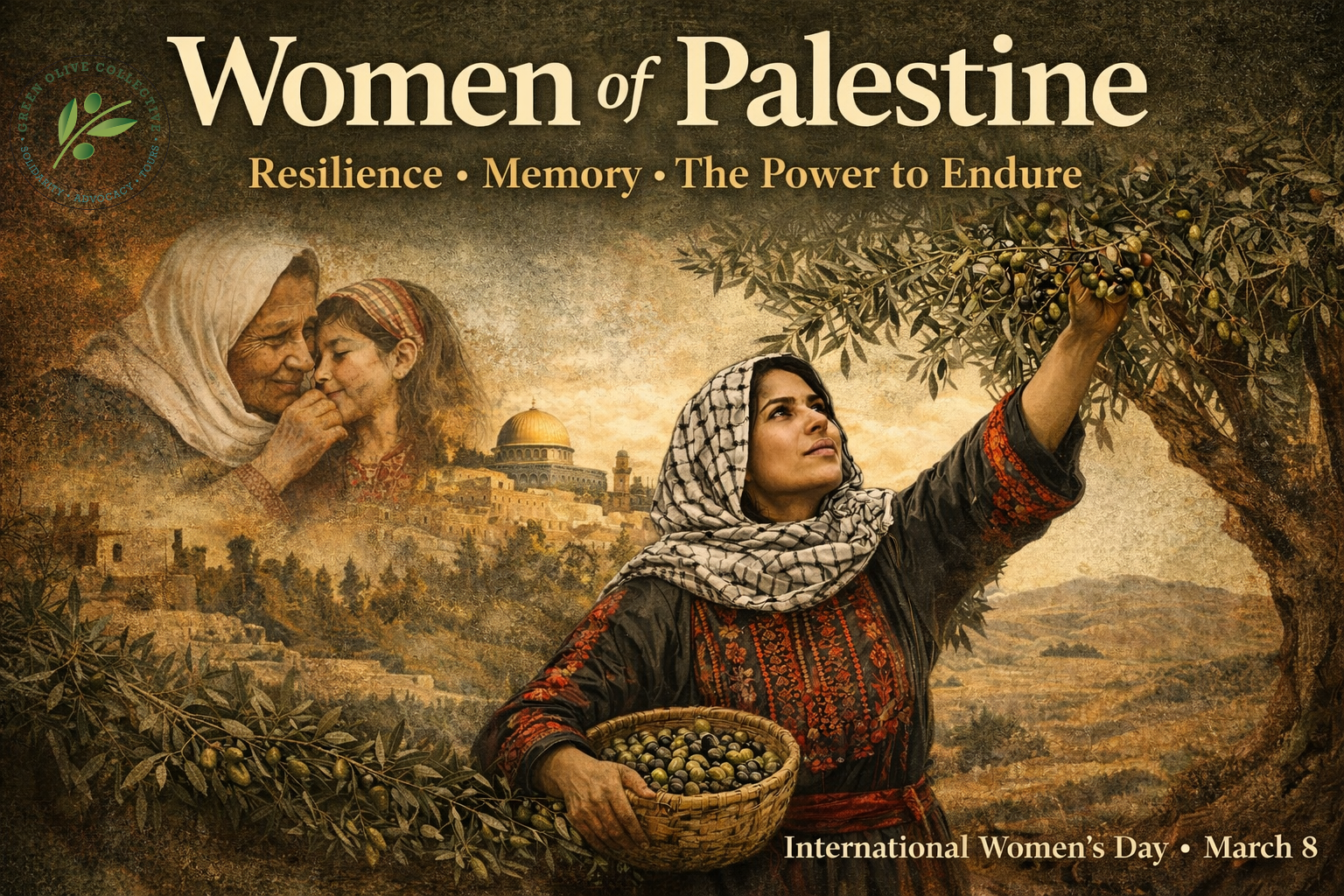
Honouring the Women of Palestine and the Middle East on International Women’s Day
In Palestine, the story of the land cannot be told without the women who have carried it across generations.
They are the farmers who rise before sunrise to tend ancient olive groves. They are the teachers who shape young minds in classrooms across cities and refugee camps. They are journalists who document realities the world often struggles to see. They are artists, organizers, caregivers, and leaders who continue to nurture life despite extraordinary challenges.
On International Women’s Day, the world celebrates the achievements of women. In Palestine, however, the day holds a deeper meaning. It is a moment to recognize the resilience, courage, and unwavering strength of women who continue to sustain communities under some of the most complex political and social conditions in the world.
Women make up nearly 49% of Palestinian society. They represent more than 60% of university graduates, reflecting a generation of highly educated and ambitious young women. Yet despite these achievements, women’s participation in the labour force remains around 19%, one of the lowest rates globally. These numbers reflect the structural barriers women face, but they also highlight the remarkable determination with which Palestinian women continue to contribute to their communities.
Across Palestine, from the Galilee and the cities within the ’48 lands, to Jerusalem, the West Bank, and Gaza, women have long been guardians of memory and identity.
They preserve traditions, protect the land, and pass down stories that sustain cultural continuity. In many rural communities, women play a central role in agriculture, particularly in the cultivation of olive trees — a symbol deeply rooted in Palestinian heritage and resilience.
But Palestinian women are not only keepers of tradition; they are also architects of change.
Poets like Fadwa Tuqan transformed personal struggle into powerful literature that resonated across the Arab world. Writers such as Sahar Khalifeh explored the intersection of gender, politics, and society through groundbreaking novels. The late journalist Shireen Abu Akleh became a global symbol of truth and courage, dedicating decades to documenting the realities of life under occupation.
Filmmakers including Mai Masri and Annemarie Jacir have brought Palestinian stories to international audiences, using cinema to challenge stereotypes and reclaim narrative space.
Yet perhaps the most powerful stories belong to the countless women whose names are not widely known, the mothers who hold families together during times of uncertainty, the farmers who protect threatened lands, the teachers who nurture hope in classrooms, and the community organizers who continue to build networks of solidarity and resilience.
Their daily acts of perseverance shape the future of Palestinian society.
Across the wider Middle East, women share similar journeys of resilience and transformation. From grassroots activism to education and cultural production, women throughout the region continue to challenge injustice and expand opportunities for future generations.
Despite political instability, economic pressures, and social barriers, women remain central to the social fabric of their communities.
At Green Olive Collective, we believe that meaningful solidarity begins with listening to these voices and amplifying their stories. Supporting women-led initiatives, strengthening local communities, and fostering global connections are essential steps toward building a more just and compassionate world.
On this International Women’s Day, we honour the women who continue to plant hope, even in the most difficult circumstances.
Like the olive tree, their roots run deep.
And like the olive tree, their resilience endures.
Sources:
PCBS (Palestinian Central Bureau of Statistics). Women and Men in Palestine Report.
World Bank. Female labor force participation rate – Palestine.
UN Women. Gender Equality in the Occupied Palestinian Territory.
UNDP. Gender and Development Reports.
UNESCO. Education and Gender Data.

Comment (0)